


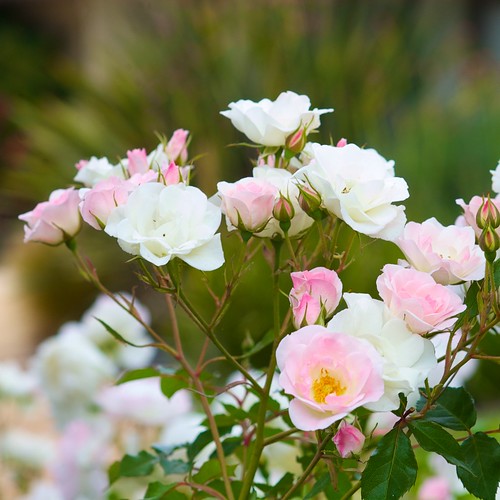
Some of the wild flowers

Devil's-bit Scabious
Succisa pratensis Height up to 75cm Perennial of damp grassland, woodland rides and marshes. Widespread and common throughout. Basal leaves are spoon-shaped; those on stem are narrow. Blue-purple flowers are borne in rounded heads, 1525mm across, and appear JuneOctober.

Field Scabious Knautia arvensis Height up to 75cm Robust, hairy biennial or perennial of dry grassland. Widespread and common but absent from

Small Scabious Scabiosa columbaria Height up to 65cm Branching perennial of calcareous grassland. Locally common only in

Greater knapweed is found growing in dry grasslands, hedgerows and cliffs on lime-rich soil. Upright branched stems terminate in single thistle-like flowerheads, each having an outer ring of extended, purple-pink 'ragged' bracts which form a crown around the central flowers. The plant has deeply dissected leaves which form a clump at the base. Greater knapweed is an attractive addition to the flower border and will grow much larger in the garden than in the wild. It prefers a sunny position in dry, alkaline soil. Like its close relatives in the huge daisy family, this species is very valuable to bees. It is also a magnet for many species of butterfly. Among them is the marbled white, which may occasionally venture into gardens near wild grassland.

Lesser Knapweed: Hardy perennial and member of the Daisy family. Found on cliffs and grassland. Deep pink, many-petalled flowers opening out from a hard bud. Grows to 65 cm (25.5 in). Flowers June to September. Tolerant of coastal conditions and fairly drought-resistant. Attracts butterflies, particularly Tortoiseshell and Painted Ladies, Satyr Pug, Silver Y and Lime Speck Pug moths, and birds like the seeds. Other butterflies - Comma, Silver Washed Fritillary, Marbled White, Meadow Brown, Ringlet, Small Skipper, Essex Skipper, Silver Spotted Skipper, Chalkhill Blue.

Common Yarrow -(Achillea millefolium LINN.) Yarrow grows everywhere, in the grass, in meadows, pastures, and by the roadside. As it creeps greatly by its roots and multiplies by seeds it becomes a troublesome weed in gardens, into which it is seldom admitted in this country, though it is cultivated in the gardens of

Yellow Rattle is attractive, partially parasitic, grassland annual. Once it is established it can reduce the competitive vigor of certain grasses, by up to 50%, thus benefiting other sown wild flowers. Yellow Rattle seed must be sown in autumn as it needs to be chilled through the winter to trigger its germination the following spring. Yellow Rattle can be sown as part of a mixture, or on its own into established grassland prepared as below.

Corn Marigold: Chrysanthemum segetum Height up to 50cm (golden cornflower, guild weed, yellow daisy, yellow ox-eye) Hairless annual of cultivated ground, mostly on acid, sandy soils. Widespread and locally common although much reduced in range and abundance. Leaves narrow and deeply lobed. Bright yellow flowers, 30-60mm across, appear June October.

Corn-cockle is a once common flower that has been effectively eradicated from the cornfields it used to populate. The flowers are large with 5 red-purple petals and 5 narrow sepals protruding beyond them. In flower during the summer months, now restricted to sites that have been specially seeded.
 The Cornflower Centaure cyanus) also known as Bachelor's button, Basket flower, and Boutonniere flower is a small annual flowering plant in the family Asteraceae, native to Europe. It is an annual plant growing to 40-90 cm tall, with grey-green branched stems. The leaves are lanceolate, 1-4 cm long. The flowers are most commonly an intense blue color, produced in flower heads (capitula) 1.5-3 cm diameter, with a ring of a few large, spreading ray florets surrounding a central cluster of disc florets. The blue pigment is protocyanin, which in roses is red.[1] In the past it often grew as a weed in crop fields. It is now endangered in its native habitat by agricultural intensification, particularly over-use of herbicides, destroying its habitat; in the United Kingdom it has declined from 264 sites to just 3 sites in the last 50 years.[2] It is also however, through introduction as an ornamental plant in gardens and a seed contaminant in crop seeds, now naturalized in many other parts of the world, including North America and parts of Australia.

The Corn Poppy, Field Poppy, Flanders Poppy, or Red Poppy is the wild poppy of agricultural cultivation—Papaver rhoeas. It is a variable annual plant. The four petals are vivid red, most commonly with a black spot at their base. In the northern hemisphere it generally flowers in late spring, but if the weather is warm enough other flowers frequently appear at the beginning of autumn. It has a variety of common names.

Harebell Perennial plant of the bellflower family, with bell-shaped blue flowers, found on dry grassland and heaths. It is known in

Cowslip Wild flower and member of the Primrose family. Its name derives from "cowpat",(Old English "cuslyppe") from where Cowslips would spring up when they were common in the wild. Also known as Paigle, Key Flower, Fairy Cups and Mayflower. This hardy perennial grows to a height of 12 ins (30 cm), liking a well-drained and sunny aspect. Pretty clusters of small primrose-like yellow flowers on stalks during April and May. According to legend, St Peter dropped the keys to Heaven and where they landed Cowslips grew (the flowers were thought to resemble a set of keys). It has been used since ancient times to make wine, jam, tea and ointment. Indeed, Cowslip wine, made from the "peeps" (yellow petal rings) was thought to be a good sedative). Its natural habitat is in meadows and woodland, with a particular preference for chalky soil. It has also been used as a sedative. The whole herb/roots has also been used in the treatment of coughs and bronchitis. Cowslips have also been used for hundreds of years to treat spasms, cramps, rheumatic pain and paralysis - used to be called Palsywort for this reason. Leaves can also be used for healing wounds. Both the flowers and leaves often used to be eaten – young Cowslip leaves were eaten in salads or mixed with other herbs to stuff meat. Flowers can be eaten to strengthen the brain. In the 18th century, powdered roots boiled in ale were used for treating giddiness and nervous ailments. Cowslips used to be popular in Elizabethan knot gardens.

Wild Daffodil: Narcissus pseudonarcissus eight up to 50cm Bulbous perennial of open woods and meadows. Locally common in parts of E
 ENGLISH BLUEBELL (Hyacinthoides non-scripta) these pretty bulbs are located in open woodlands, or under deciduous trees, especially near the sea. In the garden they can be planted in a border or amongst herbaceous plants, and need regular splitting. Situation sun/partial shade. Soil type acid/neutral normal. Height up to 50cm. flowering season + color: April-June, blue.


Flower Market This Week


The LA Flower Market was beautiful again this morning. Wednesdays are always the best days to go....everything is so fresh and abundant. It's virtually impossible to not fall in love with all the color! Today some of my favorites and new on the market for the month were Eremerus & Giant Aliums. Both strange names..and interesting looking flowers actually.
The Eremerus come in 4 -5 foot lengths in shades of white, yellow, peach/orange & pink. They last quite a long time.
The Giant Alium balls come in this great purple tone (sometimes in white but we don't see them much). Super fun and funky!

Of course, i can never get enough of the hydrangea. The available colors right now are so yummy!! Sherbert peachy/pink, vibrant fushcia, petal pink, purple, blue, lavender....i can go on and on! Hydrangea is a staple flower in our shop so when the variety of color hits the market i'm just so excited!


Subscribe to:
Posts (Atom)


